
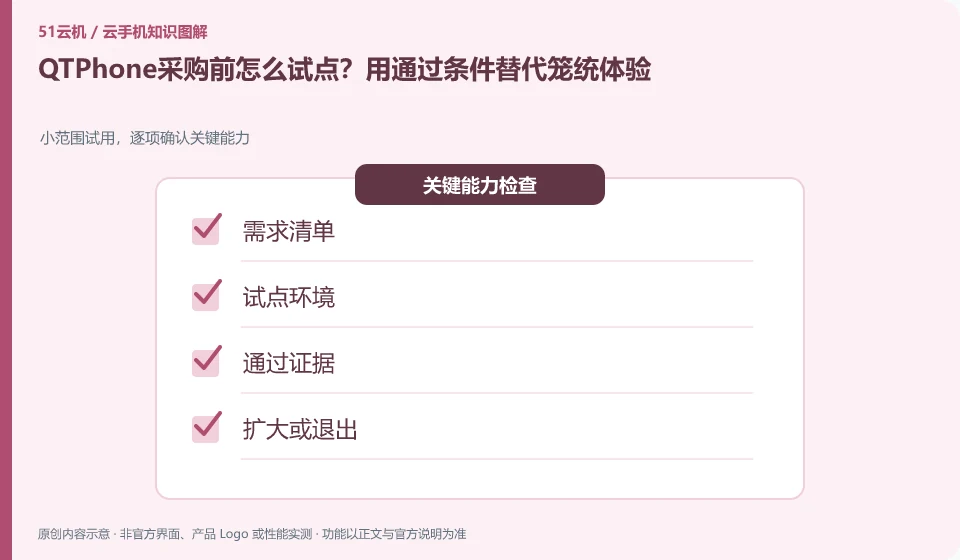
Regarding QTPhone, the key to this issue is: the pilot should first write down the tasks, personnel and exit conditions that must be passed, and then apply for equipment. Only letting a few people use it casually makes it difficult to discover permissions, data and long-term cost issues, and it is also difficult to judge whether it can be expanded in the future.
Known information about QTPhone and the key points of this verification
QTPhone official product page introduces ARM cloud Android devices. Pages list multi-device management, environment isolation, team roles, and legal automation scenarios.
Public pages were able to confirm product positioning but lacked independent evidence of performance, so the pilot used a verifiable process rather than ranking conclusions.
The evidence boundary of this article is: it has not achieved independent performance, multiple improvement or unlimited instance capability verification, and it does not make capacity commitments based on the promotional text.
How this issue applies to this product
QTPhone's public product page can confirm its ARM cloud Android, multi-device and team scenario positioning, but does not provide independently verifiable performance conclusions this time. Team pilots should write this evidence boundary at the beginning: validating their own processes rather than looking for a number that claims unlimited instances or multiple improvements.
First identify an administrator and a small number of members, and prepare the same version of the application without sensitive content. Confirm the creation and assignment item by item, the actual visible scope of the member, whether repeated tasks have results, and whether access ends after revoking authority. If you plan to use the automated portal, you should also add tests for login failure and task cessation. The results of the pilot can determine the next step of procurement, but they cannot directly become an industry-wide ranking. If there is insufficient evidence of role or log capabilities in the current version, they should be listed as pending, without relying on a shared master account to cover the gap.
Reports can be organized by required, restricted, and pending items. If the necessary items fail, the expansion will be suspended, the restricted items will explain the conditions of use, and the unconfirmed items will continue to look for official evidence; in this way, even if there is no performance score, you can get results that can be used for the next decision, rather than an empty usability evaluation.
Understand what this question covers
Select representative applications and network environments, covering normal operations, abnormal disconnections, data export and member exit. Write the passing evidence for each item, mark the content that cannot be covered separately, and do not write the lack of evidence as default support. After the pilot is completed, the configuration list is retained for easy reuse or comparison with other solutions.
Check in this order
- Establish requirements, test steps, passing criteria, and responsible person lists.
- Complete normal and abnormal processes in a small number of environments and record evidence.
- Determine rectification, expansion or exit based on failed items and retain a copy of the data.
Sources and scope
Sources checked on October 26, 2026. This article combines AI-assisted research of public information with independent analysis and verification suggestions; we have not conducted a hands-on test of this product. Features and costs depend on the current official documentation and your order.
Continue reading:Cloud phone basics · Cloud phone troubleshooting guide · Brand reference directory。
Related questions to explore
- Assigning QTPhone devices to a team: roles and offboarding
- Starting QTPhone automation: define success and stopping conditions
- Assessing QTPhone capacity: test simultaneous work, not idle connections
Back to the brand and product knowledge directory · Browse cloud phone topics