
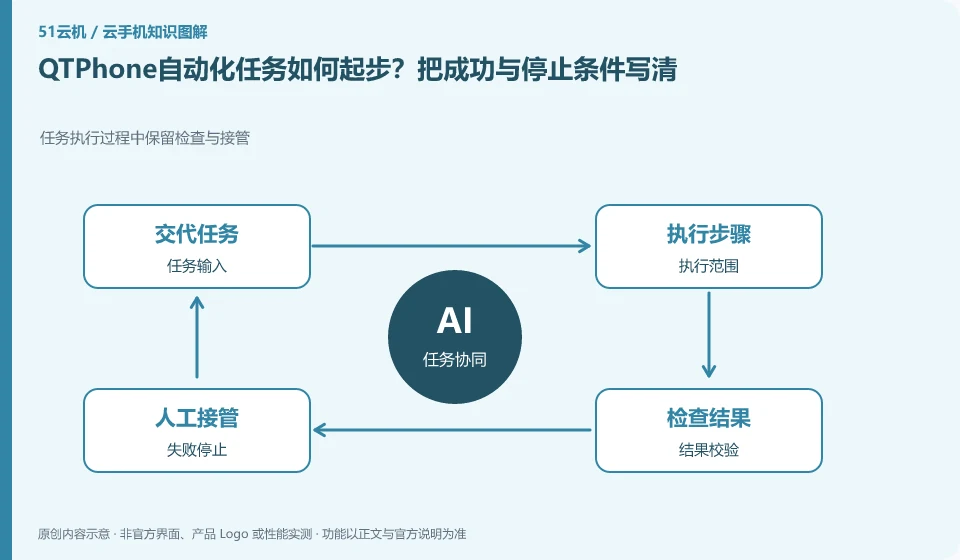
Regarding QTPhone, the key to this question is: automation should start with a small number of repetitive, observable legitimate tasks. Timing triggers, synchronous clicks, scripts and AI understanding interfaces are different capabilities; being able to start a task does not mean that it can be judged to be completed, nor does it mean that it can bypass third-party application rules.
Known information about QTPhone and the key points of this verification
QTPhone official product page introduces ARM cloud Android devices. Pages list multi-device management, environment isolation, team roles, and legal automation scenarios.
The product page uses timing and scripting for legitimate testing scenarios. This article does not claim that any App automates or bypasses verification.
The evidence boundary of this article is: it has not achieved independent performance, multiple improvement or unlimited instance capability verification, and it does not make capacity commitments based on the promotional text.
How this issue applies to this product
The QTPhone product page introduces timing and scripting in legal automation scenarios. The proper way to read them is to view them as further verifiable execution capabilities, rather than proof that any app can automatically handle them. When third-party accounts, content outsourcing or payment are involved, the rules of the target platform should still be followed and clear confirmation points should be arranged.
A test can start with a fixed page of your own application: given a trigger time, expected results, and stopping conditions, observe what happens when the login expires or the page changes. Repeated execution needs to record success and failure, and you cannot keep only one completion screenshot. The team also needs to confirm who can create, modify and stop tasks, and how to regain permission after leaving the company. The official website efficiency promotion does not define available capacity for your project. Before expanding automation to more devices, you should first determine whether abnormalities can be discovered and controlled.
If you need to allow members to modify tasks, first confirm who can change the device scope and execution time. The content of the script is harmless, and the work may be affected by the wrong selection of the target device; therefore, task authorization and device allocation should be checked together, and the completion record should be able to trace the actual execution object.
Understand what this question covers
When designing, first write the input conditions, operating range, success evidence and abnormal stop point. When the network is interrupted, the login fails, or a pop-up window appears, the program should avoid endless retries. Separating real accounts and test data, retaining logs and then expanding the scope is easier to maintain than leaving long processes unattended.
Check in this order
- Choose a single reversible process and write down the evidence of input and completion.
- Limit the number of executions in the test environment and observe whether to stop when exceptions occur.
- Record the results and reasons for failure, and then increase the scope of the task after correction.
Sources and scope
Sources checked on October 26, 2026. This article combines AI-assisted research of public information with independent analysis and verification suggestions; we have not conducted a hands-on test of this product. Features and costs depend on the current official documentation and your order.
Continue reading:Cloud phone basics · Cloud phone troubleshooting guide · Brand reference directory。
Related questions to explore
- Assigning QTPhone devices to a team: roles and offboarding
- Assessing QTPhone capacity: test simultaneous work, not idle connections
- Does QTPhone environment isolation guarantee account safety?
Back to the brand and product knowledge directory · Browse cloud phone topics