
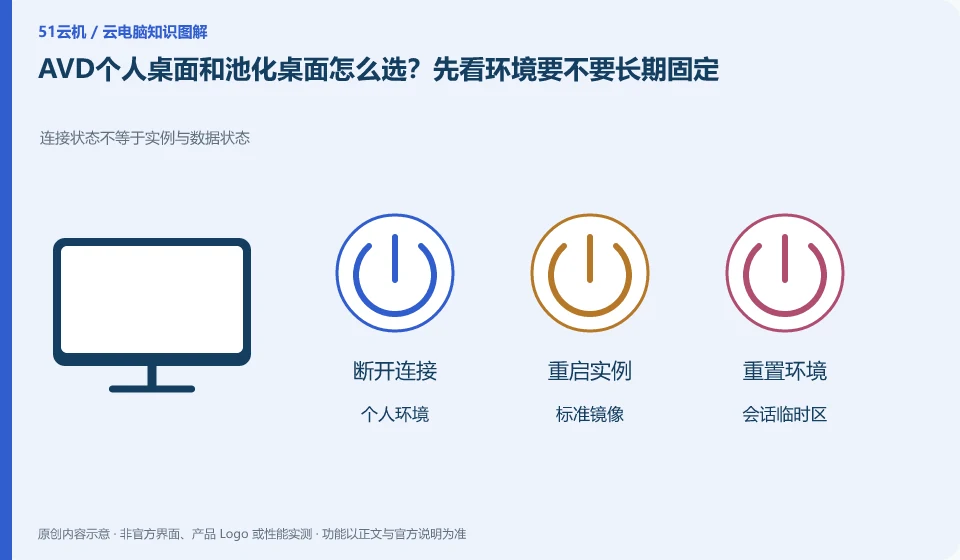
The choice between personal and pooled methods should be based on user environment, concurrency and data retention needs. Microsoft outlines the distinction between personal persistent desktops and pooled resources. The total number of accounts cannot be directly regarded as pooled capacity or exiting and restoring as a failure.
Who this is for:General readers and small teams who are working on Microsoft Azure Virtual Desktop and need to solve the specific problem in the title. Data verification date: 2026-10-26.
First, identify the product line
Azure Virtual Desktop can deliver a complete desktop or RemoteApp, and administrators need to plan host pools, application groups, users, and images. It belongs to the same Microsoft desktop system as Windows 365, but has different resource organization and operation and maintenance responsibilities, so it is suitable for design based on workload.
Persistent and non-persistent desktops determine preservation strategy
Fixed personal development environment and standardized short-term training have different requirements. List the configurations and rebuildable systems that must be retained, and then verify the behavior when logging off, reconnecting, and changing hosts; the data preservation plan must be prepared before large-scale user entry.
Persistent desktops are typically designed around long-term retention of personal environments, while non-persistent desktops are more like a standard environment with resources allocated on a per-session basis. Both can have data saving schemes, but the saving location and dependency conditions are different. Do not directly interpret "the desktop is restored after exiting" as a service failure, nor should a successful reconnection prove that all user settings are permanently retained.
Three categories of status need to be listed first: systems and applications that can be generated repeatedly, personal data that must be retained, and temporary files that are only used in this session. Specify the storage method and responsible person for each type of status. During the test, the four actions of disconnecting, logging off, restarting, and rebuilding were performed to confirm which operations would trigger the restore; before actually executing the test that would clear the data, worthless samples should be used and backed up.
Check each requirement for your task
- Confirm whether the desktop is a personal persistent environment or a pooled non-persistent environment.
- Specify the storage locations for system, personal data and temporary files respectively.
- Use the sample to check the difference between disconnection and logout, and complete independent export of important data.
The desktop pool cannot be estimated based only on the total number of people
Capacity verification should include login peaks, application startup and exit recycling. Testers use the same baseline task, mix in a small amount of real heavy load, and look at response, memory and storage rather than just the CPU. Scaling up and down also involves data location, permissions, and task interruption, so set clear trigger conditions and fallback paths. When user experience declines, first look at session and resource indicators to avoid blindly increasing all specifications.
Where the conclusion applies and what to do next
Do not copy the old tutorial of the classic version of Azure Virtual Desktop; Microsoft's overview document has given a reminder to retire the classic version, and you should check the current resource model.
This article is based on public information. We have not purchased or tested the product. The scenarios describe ways to verify suitability, not customer case studies. Features and terms depend on the current official documentation for the relevant version.
Official sources and further reading
- Azure Virtual Desktop overview: Official description of complete desktop, RemoteApp, personal and pooled resources and classic version retirement information.
- Azure Virtual Desktop prerequisites: Identity, platform, and deployment prerequisites reference.
- Azure Virtual Desktop Documentation Entry: Current documentation and quick start portal, without borrowing steps from other desktop products.
Read more:Cloud PC knowledge hub · Find an article for your question · Microsoft Azure Virtual Desktop product line identification
Related questions to explore
- Azure Virtual Desktop host pools, application groups and workspaces explained
- AVD RemoteApp versus a full desktop: publish only what is needed
- Can you still use classic AVD tutorials? Check retirement and resource models
Back to the brand and product knowledge directory · Browse cloud PC topics