
The official documentation corresponding to the current project version should prevail. RAS has a version management guide. Old version deployment and client articles can help understand the concepts, but they cannot automatically be used as new version production steps.
Who this is for:General readers and small teams who are working on Parallels RAS, need to solve specific problems in the title. Data verification date: 2026-10-26.
First, identify the product line
Parallels RAS official description covers virtual application, desktop and remote PC delivery, and can be combined with different infrastructures. It's a different product than Parallels Desktop, which runs virtual machines locally on a Mac; organizations deploying RAS still need to arrange hosting resources, identity and software authorization.
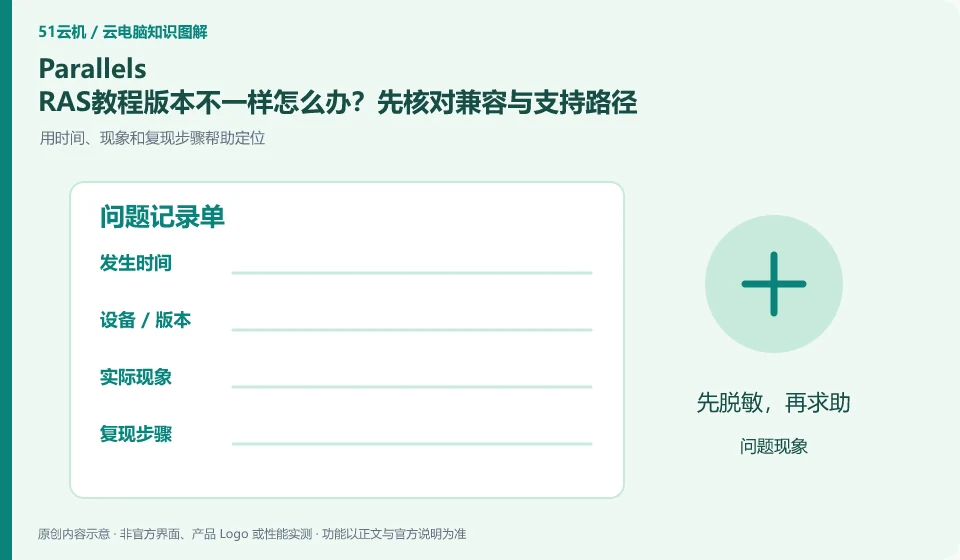
Problem records are written in steps that can be reproduced by others.
Take inventory of clients, management components, hosting platforms, and business applications, and then check the upgrade support path. In the test environment, run the complete task first, retaining fallback conditions and maintenance windows; when encountering name changes, check the version notes first, and do not install old components of unknown origin and collect screenshots.
An effective fault record should include both expected results, actual results, time of first occurrence, client and system versions, and repeatable steps. Changing "Cannot Open" to "Select a desktop and stop at the loading interface, the same account still appears when changing terminals" can narrow the scope of the problem. Images and logs may contain device code, file paths or account numbers, and must be masked before being sent to support.
Don't pile together unfounded troubleshooting methods. First confirm the official status and announcement, and then distinguish between account, resource, network, application or terminal problems. Record the results every time you make an adjustment to avoid not knowing which operation took effect in the end. When communicating with customer service, you can ask for the work order number, next step evidence, and return visit method. There is no need to send SMS verification codes or complete remote control permissions to unofficial personnel.
Check each requirement for your task
- Record time, version, node and expected and actual results.
- Use the shortest path to reproduce and check accounts, networks and applications one by one.
- After desensitization, submit the official work order and retain the number and the results of each adjustment.
Migration requires an old environment that can be returned to
When migrating from a local computer or another service, the old environment should not be deleted initially. First, take inventory of applications, data, accounts, peripherals, and authorizations, and then copy the transferable data to the test environment. System images can help restore the environment, but different hardware, virtualization platforms, and software licenses may not allow direct migration; the official migration methods of the source and target platforms must be found out.
Where the conclusion applies and what to do next
Buying Mac local virtual machine software is not equivalent to buying a cloud PC, and the RAS client is not a separate cloud computing resources package.
This article is based on public information. We have not purchased or tested the product. The scenarios describe ways to verify suitability, not customer case studies. Features and terms depend on the current official documentation for the relevant version.
Official sources and further reading
- Parallels RAS Product Introduction: Official explanation of the positioning of desktop, application delivery and integration with infrastructure.
- Parallels RAS client download: Terminal client entrance, which needs to be used in conjunction with the resources released by the organization.
- Parallels RAS Documentation: Versioned deployment, management and client reference material.
Read more:Cloud PC knowledge hub · Find an article for your question · Parallels RAS product line identification
Related questions to explore
- Parallels RAS versus Parallels Desktop: what is the difference?
- Testing a single Windows app published through Parallels RAS
- Does deploying Parallels RAS in the cloud equal buying a cloud PC?
Back to the brand and product knowledge directory · Browse cloud PC topics