
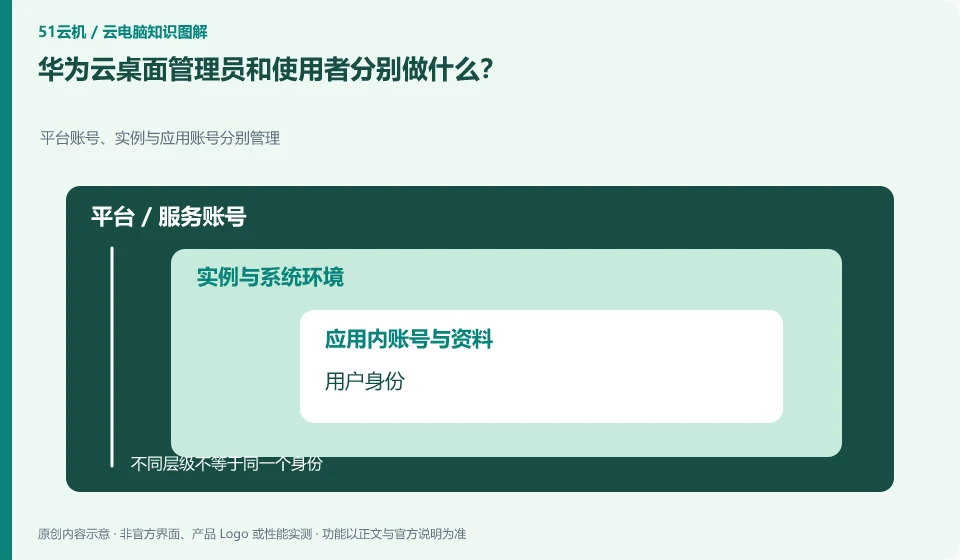
Administrators are responsible for resources, people, and policies, and users are responsible for connecting and completing work. Huawei Cloud has an independent administrator guide. Before deployment, responsibilities such as creation and distribution, daily support, and account recycling should be clearly stated to prevent everyone from using the administrator identity.
Who this is for:General readers and small teams who are studying Huawei Cloud Workspace and need to solve the specific problems in the title. Data verification date: 2026-10-26.
First, identify the product line
Huawei Cloud Workspace product documentation defines it as a cloud desktop, and users and administrators have different configuration and management tasks. When enterprises deliver desktops on the cloud, in addition to virtual machine configuration, they should also arrange accounts, networks, desktop policies, and operation and maintenance to form a usable working environment.
Check identity, licensing and desktop assignment together
Small teams can also create a responsibility list: who opens the desktop, who approves file export, who assists in recovery, and who decides on release. During acceptance, use ordinary accounts and administrator accounts respectively to avoid only high-privilege tests being successful and employees actually logging in but having no resources.
Successful login does not guarantee an available desktop. Organizing desktops generally also requires users to be assigned to corresponding resources, application groups or workspaces; identity authentication, access authorization and desktop preparation are three things. If you encounter a blank list, first ask the administrator to check the organization and resource allocation to which the account belongs, instead of repeatedly changing passwords or creating multiple new accounts.
It is recommended to use a role list to record what resources are needed by ordinary employees, temporary collaborators and administrators. Minimum permissions are granted when you join the company, resources are adjusted when you are transferred, and sessions are recycled and legally saved work materials are handed over when you leave. Test accounts should be isolated from production identities, and automated scripts should avoid using personal high-privilege credentials. This upgrades "can log in" to "access only approved work environments."
Check each requirement for your task
- Check the account organization, identity source and current login subject.
- Check to see if the user is covered by a resource, app group, or desktop assignment.
- Verify with a general authority account and record the recycling actions of onboarding, transfer and resignation.
Validate a small deployment before scaling up
Bringing the organization's desktop online is a business switch, not just installing the client. First select a group of representatives including ordinary office workers, heavy users of peripherals and different network conditions, and record the steps they take to complete the task. The pilot should clearly define the responsible person, work order entry, rollback plan and shutdown window; the acceptance criteria come from whether the work is completed, not how many functions are listed on the promotional page.
Where the conclusion applies and what to do next
Huawei Cloud Workspace is not the same delivery method as the desktop mode, ordinary cloud server, and local virtual machine software of Huawei mobile phones.
This article is based on public information. We have not purchased or tested the product. The scenarios describe ways to verify suitability, not customer case studies. Features and terms depend on the current official documentation for the relevant version.
Official sources and further reading
- Huawei Cloud: What is cloud desktop:Officially defines Workspace cloud desktop and explains the positioning of enterprise desktop delivery.
- Huawei Cloud Desktop Administrator User Guide: Administrator resource, user and policy operation reference; subject to the corresponding regional console and version.
- Huawei Cloud desktop product introduction: Background information on desktop product capabilities and network isolation.
Read more:Cloud PC knowledge hub · Find an article for your question · Huawei Cloud Workspace product line identification
Related questions to explore
- Huawei Cloud Workspace versus a cloud server: what is the difference?
- Planning a Huawei Cloud Workspace network around application access
- Copy and paste blocked on Huawei Cloud Desktop: check policies first
Back to the brand and product knowledge directory · Browse cloud PC topics