
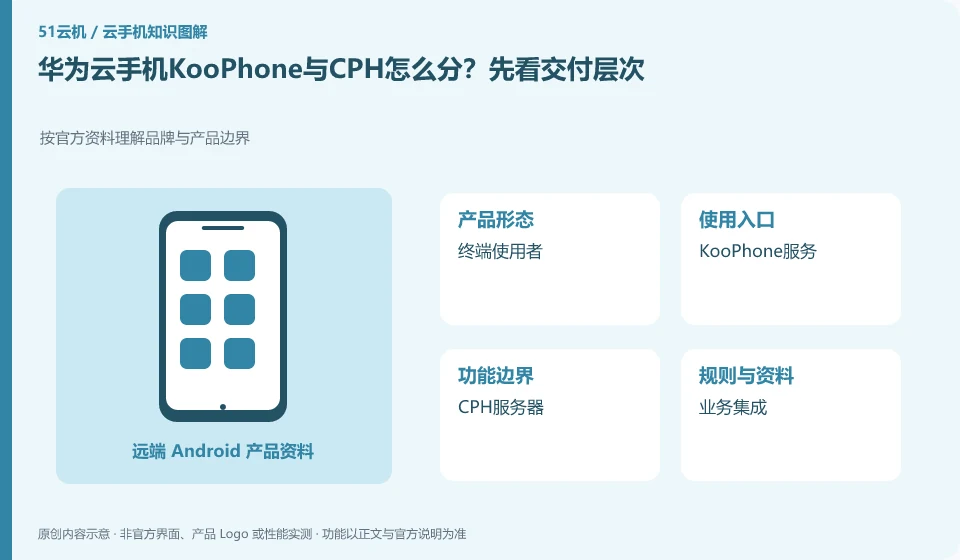
Regarding Huawei Cloud phones, the key to this issue is: KooPhone cloud phone service and CPH cloud phone server need to be understood based on delivery and management methods. They cannot be lumped into one package just because they include the Android environment. First confirm whether you want to obtain a terminal user experience or build your own application and access system.
Known information about Huawei Cloud phones and the key points of this verification
Huawei CloudKooPhone and cloud phone server CPH are service levels that need to be distinguished. KooPhone documentation provides examples and node concepts; CPH documentation provides server and access management instructions.
Both lines are related to Cloud Android, but service delivery and underlying server responsibilities are different, and the KooPhone and CPH documents should be consulted respectively.
The evidence boundary of this article is: the activation, SDK and billing models of the two product lines cannot be directly equivalent, nor does it mean that all third-party application authorizations will be automatically obtained after purchase.
Understand what this question covers
For enterprises, differences impact administrator responsibilities, SDK integration, instance lifecycle, and network configuration. Before making an inquiry, first draw the relationship between the user, business backend and cloud resources, and refer to the documentation with the specific process; ordinary users should not treat the underlying server product as a downloadable consumer app.
Consider a specific scenario
Suppose you are planning to organize your organization to choose between terminal services and integration with underlying resources. This is a verification plan, not our experience using this product. First of all, "delivery levels, maintenance responsibilities and terminal entrances should be clearly defined" as the completion standard for this time. The original data should be saved before testing, and the first attempt should not be placed directly on important accounts and unique file copies.
The most easily overlooked thing in this scenario is that mixing the names of the two lines will cause the quotation and technical scope to be misaligned. Therefore, it is necessary to separate the status that can be seen on the interface from the results that really need to be delivered. Being able to reproduce, explain and withdraw is more valuable than getting only one success notification.
Check in this order
- Write down who controls the device, who assigns accounts, and who maintains the business end.
- Please refer to the activation and access instructions for the two product lines respectively.
- Inquire about the scope of delivery based on the same pilot requirements, and then select the appropriate service.
A reusable verification log
You can copy the table below into your notes. Record the device ID, verification date and current version. It helps identify which step failed and lets you repeat the same checks after changing clients or services.
| Checkpoint | What counts as a pass | What to do if it fails |
|---|---|---|
| Service division of labor | Underlying resources, background management and terminal user roles are clear | When there is only a resource without a user process, the delivery link is not considered completed. |
| Configuration relationship | Record the impact of unified configuration and single-unit changes | If the scope is unclear, verify it in the test group first to avoid covering the official environment. |
| Credentials | Clarify which credentials are left in the background and which can be given to the user for a short period of time | When sensitive credentials are found entering the client, stop expanding access first. |
| Full chain verification | There is a complete set of results from creation to access to exit | If the example succeeds only once, continue to test reconnection, revocation and life cycle. |
How to hand over records to the support channel of Huawei Cloud phone
When submitting a question, first write "How to differentiate between Huawei Cloud phone KooPhone and CPH? First look at the delivery level." Then attach the device number, selected client and system version, failure steps, and current time. The key point of verify in the brand information is that "both lines are related to cloud Android, but service delivery and underlying server responsibilities are different, and the KooPhone and CPH documents should be compared respectively." Therefore, do not just send a screenshot of the homepage, nor do you need to put the complete password, verification code or private key in the problem description. When it comes to order or business qualifications, you should contact support from the official entrance where this product can be verified.
Sources and scope
- KooPhone cloud phone service overview
- Huawei CloudKooPhone product page
- Huawei CloudCPH product introduction
Sources checked on October 26, 2026. This article combines AI-assisted research of public information with independent analysis and verification suggestions; we have not conducted a hands-on test of this product. Features and costs depend on the current official documentation and your order.
Continue reading:Cloud phone basics · Cloud phone troubleshooting guide · Brand reference directory。
Related questions to explore
- Huawei cloud phone instance and node editions: budgeting and management units
- Huawei cloud phones for work: data and organizational requirements
- Huawei cloud phone SDK integration: console management versus end-user access
Back to the brand and product knowledge directory · Browse cloud phone topics