
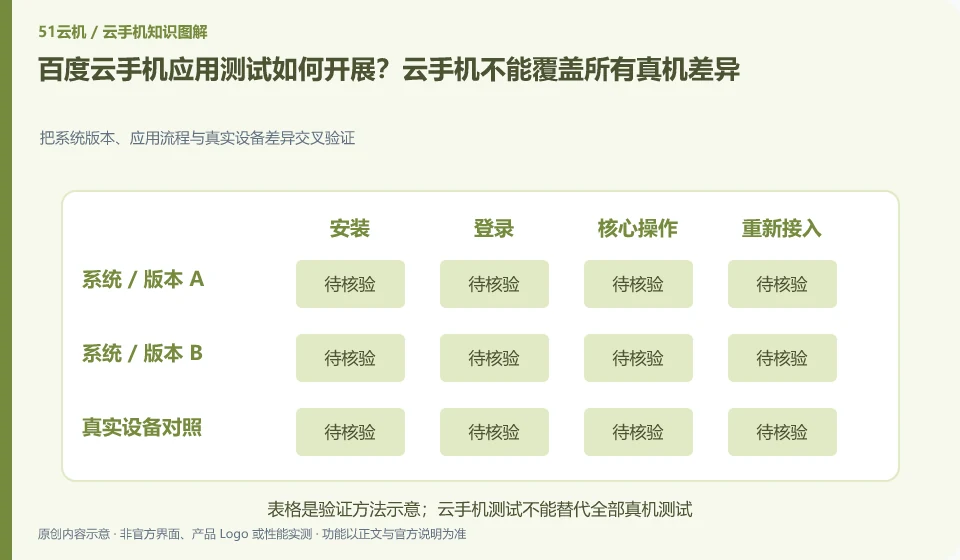
Regarding Baidu Cloud Phone, the key to this issue is: Cloud Phone is suitable for repeated installation and standardized process verification, but it cannot automatically replace all sensors, vendor systems and power consumption performance on different physical phones. The test objectives should clearly state what is covered and what is not covered so that the results will not be over-interpreted.
Known information about Baidu Cloud Phone and the key points of this verification
Baidu AI Cloud cloud phone product provides cloud Android instance capabilities for enterprises. Official information distinguishes basic services from the ready-made client and operating platform capabilities of the Quick Edition.
The native Android and compatibility introduction on the official website does not replace the application test matrix, and the test conclusions only cover the versions and conditions in the records.
The evidence boundary for this article is: the merchant identity, order, and support boundaries between consumer brands and enterprise cloud services cannot be confused.
How this issue applies to this product
Baidu AI Cloud cloud phone provides Android resources to enterprises. The test team must first confirm whether they have access to basic capabilities or the Quick Enjoy product line. The division of labor between resources, terminal portals and operating platforms is different. The test report should record the actual product form used. You cannot just write "Baidu cloud phone" and omit the environment source.
Application verification can start from fixed images and package versions, covering installation, core processes, reconnection, and file exports; when automatic repetition is needed, the respective steps of SDK control and background resource management should be clarified. The native Android and compatibility descriptions on the product page are not test results, and passing a certain application only covers the current version and configuration. The company's real name and activation conditions are preparation steps and are not performance indicators. Partial supplementary testing involving physical hardware and third-party certification is clearly defined to avoid treating cloud Android instance reports as full-model certification.
If the test environment has updated images or application packages, the new round of results should be identified separately. Historical pass records are still valuable, but they should not be quietly changed to pass new versions; saving baselines by version can analyze regression changes, rather than just retaining a long-term compatibility label.
Understand what this question covers
Save Android version, app version, configuration and reset method for each test environment. Test certain processes such as login, permissions, pages, and files, and then list parts that rely on physical hardware or special system policies as real machine supplementary testing. Failure records should be reproducible, not just "stuck" or "incompatible".
Check in this order
- Establish a system and application version matrix and determine the initial status of each round of testing.
- Execute canned use cases and save inputs, screenshots and actual results.
- Arrange hardware and system differences not covered by the cloud environment to be reviewed on real machines.
Sources and scope
- Baidu AI Cloud cloud phone product page
- Baidu AI Cloud Android cloud phone usage reference
- Baidu cloud phone official documentation
Sources checked on October 26, 2026. This article combines AI-assisted research of public information with independent analysis and verification suggestions; we have not conducted a hands-on test of this product. Features and costs depend on the current official documentation and your order.
Continue reading:Cloud phone basics · Cloud phone troubleshooting guide · Brand reference directory。
Related questions to explore
- Baidu cloud phone editions: building capabilities versus using a ready-made platform
- Before provisioning Baidu enterprise cloud phones: eligibility and responsibilities
- Baidu cloud phone SDK integration: console management versus user access
Back to the brand and product knowledge directory · Browse cloud phone topics